
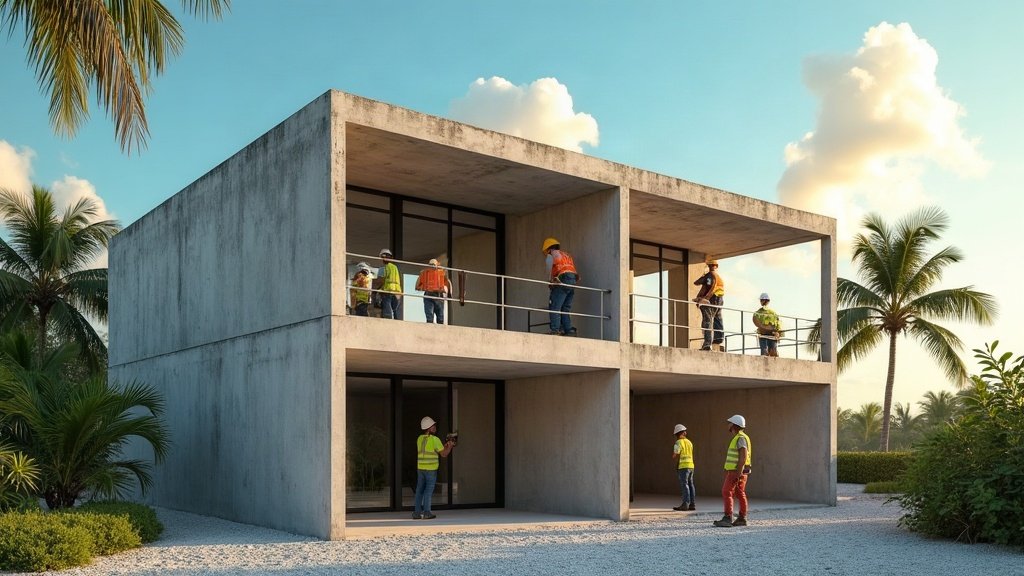
Building Resilient Homes: Integrating Concrete and Offsite Manufacturing for Caribbean Construction
Construction in the Cayman Islands demands materials and methods that can withstand the unique pressures of our island environment. Between hurricane season, salt-laden air, intense UV exposure and high humidity levels, standard building techniques often fall short of long-term durability expectations. Property owners and developers frequently discover that shortcuts in material selection or construction methodology lead to costly repairs, structural compromise and premature deterioration—expenses that could have been avoided with forethought and quality integration from the outset.
The combination of concrete construction and offsite manufacturing represents a modern solution that addresses these vulnerabilities head-on. By leveraging engineered concrete systems and prefabricated components produced in controlled factory environments, builders can deliver homes and commercial properties that resist tropical weather impacts while maintaining schedule certainty and cost predictability. This approach has gained traction globally and is increasingly relevant to Cayman Islands developers seeking resilience without sacrifice.
In this guide, we explore how combining these two methodologies creates measurably stronger, longer-lasting structures suited to Caribbean conditions—and why discerning property owners should prioritize this approach when planning their next project.
What It Is and Why It Matters for Cayman Islands Construction
Concrete and offsite manufacturing integration refers to the strategic pairing of reinforced concrete construction with prefabricated building components produced away from the job site. Rather than pouring concrete on-site and building frame elements traditionally, contractors manufacture structural panels, wall systems, floor assemblies and mechanical components in a controlled factory setting. These precision-engineered pieces then arrive at the site ready for assembly—minimizing on-site variability, environmental exposure during construction, and timeline uncertainties.
For Cayman Islands property owners, this matters significantly. Our building code requirements—aligned with international standards to ensure structural integrity in high-wind zones—demand exceptional concrete quality and precise engineering. Traditional site-cast concrete relies on weather conditions, worker skill consistency and material handling that can vary day to day. Factory-controlled concrete production eliminates these variables. Simultaneously, prefabrication reduces the construction timeline, which means less exposure of unfinished structures to salt spray, UV damage and unexpected weather events.
The cumulative effect is a property that meets or exceeds Cayman Islands Building Code requirements with demonstrable margin, resists environmental degradation more effectively, and delivers predictable performance over decades rather than years.
Key Benefits
- Structural resilience: Factory-produced concrete and components meet exacting standards every time, ensuring consistent strength and durability against hurricane-force winds, salt corrosion and thermal stress common in the Caribbean.
- Accelerated project timelines: Offsite manufacturing runs parallel to site preparation and foundation work, compressing overall construction schedules by weeks or months—a critical advantage when weather windows matter.
- Reduced material waste: Precision manufacturing in factories generates minimal offcuts and waste compared to traditional site construction, lowering material costs and environmental impact—both significant on an island where imported materials dominate.
- Quality assurance: Controlled factory environments with standardized equipment and experienced crews produce components with documented tolerances and performance data, eliminating guesswork about structural integrity.
- Weather protection during construction: Fewer on-site trades working in tropical humidity and salt air means reduced risk of material degradation, reinforcement corrosion and concrete weakening before the building is sealed and operational.
- Cost predictability: Factory-based production and parallel workflows reduce change orders, rework and schedule delays, making final project costs more stable and easier to forecast.
- Enhanced durability: Concrete produced and cured in controlled conditions resists salt intrusion and moisture penetration more effectively than site-cast alternatives, extending the life of the structure and reducing maintenance costs.
Best Practices and Standards in the Cayman Islands
- Engage a qualified structural engineer early: Before committing to offsite manufacturing, work with an engineer familiar with Cayman Islands Building Code requirements and our specific environmental stressors. They will specify concrete mixes, reinforcement details, and component tolerances appropriate for salt-spray and hurricane conditions.
- Verify supplier and manufacturer credentials: Partner only with factories that hold relevant quality certifications, demonstrate experience with tropical climates, and can provide reference projects from similar environments. Request material test reports and performance data.
- Coordinate with the Planning Department: Early engagement with the Cayman Islands Planning Department ensures that your proposed prefabricated approach aligns with local approval processes. Some designs may require additional documentation or phased review.
- Plan logistics with island constraints in mind: Offsite manufacturing requires careful coordination of shipping, port handling and site access. Establish clear timelines with your manufacturer and logistics partner to avoid storage delays that could damage prefabricated components in our humid climate.
- Specify concrete durability measures: Require low-permeability concrete mixes, appropriate water-to-cement ratios, and protective coatings or sealers that resist salt exposure. Document all specifications in contract documents.
- Establish quality inspection protocols: Schedule third-party inspections of components at the factory before shipment, and again upon delivery to site. Document all findings and address discrepancies immediately.
Common Mistakes and How to Avoid Them
- Underestimating lead times: Offsite manufacturing requires longer upfront planning and material procurement. Avoid compressed timelines that force manufacturers to rush production or use substandard processes. Build realistic schedules that account for design finalization, factory mobilization, and island shipping delays.
- Overlooking salt corrosion in design: Standard concrete mixes and reinforcement details used in temperate climates may prove inadequate in Cayman’s salt-air environment. Correct this by specifying concrete with enhanced corrosion resistance, epoxy-coated reinforcement, or increased concrete cover where exposure is high.
- Selecting inexperienced offshore manufacturers: Cost pressure sometimes drives developers toward low-bid producers unfamiliar with tropical construction requirements. Avoid this trap by prioritizing manufacturers with proven experience in Caribbean or similar marine environments, even if upfront costs are slightly higher.
- Poor communication between design and manufacturing: Misaligned specifications between architect drawings and factory production can result in components that do not fit, require on-site modification, or fail to meet performance standards. Correct this with detailed coordination meetings and written confirmation of all specifications before production begins.
- Inadequate site preparation: Offsite manufacturing is only as effective as the site conditions where components are assembled. Ensure foundations are set precisely to tolerance, drainage is adequate, and the site is secured against salt spray and wind exposure during the assembly phase.
- Neglecting long-term maintenance planning: While offsite manufacturing delivers durability, the structure still requires proper maintenance. Avoid assuming a factory-built home needs no protective measures; establish a maintenance schedule and educate the owner on salt-spray cleaning, sealant inspection, and drainage maintenance.
Verification Checklist
- Structural engineer has confirmed that concrete mixes and component specifications meet or exceed Cayman Islands Building Code requirements for wind and salt exposure.
- Manufacturing facility has provided material test certificates, quality control documentation, and references from projects in tropical or marine environments.
- Logistics plan is finalized, including shipping schedules, port handling protocols, site storage provisions, and weather contingencies specific to our hurricane season.
- All components have been inspected at the factory by an independent third party, with a written report documenting conformance to specifications.
- Site foundation and preparation work is complete and verified to correct tolerances before prefabricated components arrive.
- Owner and maintenance team have received documentation on protective coatings, sealant maintenance schedules, and drainage requirements to preserve the structure’s long-term resilience.
Applications and Use Cases in the Cayman Islands
Residential development: Multi-unit residential projects and estate homes benefit significantly from offsite manufacturing, which compresses construction timelines and ensures consistent quality across numerous units. This approach is particularly valuable for waterfront or elevated properties vulnerable to hurricane surge and salt exposure.
Commercial and hospitality: Hotels, resorts and office buildings gain operational continuity through faster construction schedules enabled by prefabrication. Concrete and offsite systems also provide superior noise control and fire resistance—both critical for hospitality environments.
Critical infrastructure: Medical facilities, emergency services buildings, and utility structures require maximum durability and reliability. Offsite manufacturing ensures these buildings meet stringent codes and resist environmental stressors that could compromise operations.
Renovation and adaptive reuse: Retrofitting existing structures with prefabricated concrete panels and components allows developers to upgrade older buildings to current code standards while minimizing disruption to adjacent properties and utilities.
How J&R Construction Approaches Resilient Building Integration
At J&R Construction, we recognize that building for Cayman Islands conditions demands more than standard practices. Our team has developed deep expertise in specifying and integrating concrete systems with prefabricated components that withstand our tropical climate. We collaborate with structural engineers, manufacturers and suppliers who share our commitment to durability, and we manage every detail from design coordination through final inspection.
Whether you are developing a residential community, planning a commercial property, or managing a major renovation, we bring proven methodology to combine concrete’s proven strength with offsite manufacturing’s precision and efficiency. Our approach ensures your property meets code requirements with measurable resilience, delivers on schedule, and performs reliably for decades—the foundation of lasting value for property owners and investors across the Cayman Islands.
Conclusion
Integrating concrete construction with offsite manufacturing is not a trend—it is a proven strategy for building structures that endure in challenging environments. For property owners and developers in the Cayman Islands, where salt air, hurricanes and humidity present constant challenges, this approach delivers measurable benefits in durability, schedule certainty and long-term cost performance.
If you are planning a new residential, commercial or renovation project, we encourage you to explore how this integrated methodology can strengthen your property and protect your investment. Contact J&R Construction today to discuss your project requirements and discover how our expertise in resilient building design and execution can deliver the quality and durability your Cayman Islands property deserves.
Leave a Reply