
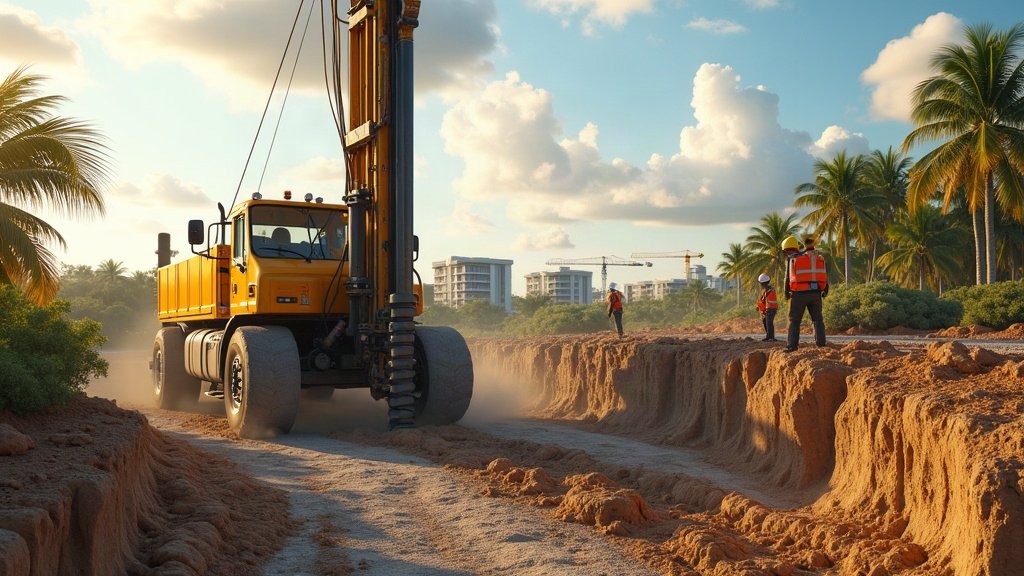
Deep Foundation Systems for Commercial and Residential Construction in the Cayman Islands
When constructing buildings in the Cayman Islands, the foundation you choose determines everything that follows. Unlike mainland jurisdictions, island properties face unique environmental pressures—from salt-laden air and hurricane-force winds to dense limestone geology and elevated water tables. For developers and property owners planning substantial commercial projects, multi-storey residential developments, or structures on challenging terrain, shallow foundations alone often prove inadequate. Deep foundation systems provide the structural stability, longevity and resilience required for demanding building projects across our islands.
This guide explores what deep foundations are, why the Cayman Islands building environment makes them essential for certain projects, and how to implement them to meet local regulations and environmental standards. Whether you’re developing a high-rise commercial tower in George Town, building a substantial residential complex, or constructing on reclaimed land or near the coast, understanding deep foundation principles is critical to project success and regulatory compliance.
At J&R Construction, we’ve managed projects where foundation selection made the difference between a structure that endures decades of Caribbean weather and one that faces premature deterioration. Let’s explore how deep foundations work and when they’re the right choice for your Cayman Islands property.
What Deep Foundations Are and Why They Matter in the Cayman Islands
Deep foundations transfer structural loads from a building down through weaker surface soil layers to deeper, more stable soil or rock strata. Unlike shallow foundations that rest on soil near ground level, deep systems extend significantly below the surface—often 20 to 100+ feet—to reach competent bearing layers that can safely support the structure’s weight.
In the Cayman Islands context, deep foundations become necessary for several reasons. Our islands sit on limestone bedrock of variable quality, overlaid with fill materials, sand and coral rubble that lack consistent bearing capacity. Hurricane loads place exceptional lateral and uplift forces on structures, meaning foundations must provide exceptional anchoring power. Salt-air corrosion, high water tables and seasonal flooding in some areas further complicate shallow foundation performance. Commercial developments, high-rise residential buildings and any structure on filled or artificially prepared land typically require deep foundation investigation and design to satisfy Planning Department requirements and comply with the Cayman Islands Building Code.
The decision to use deep foundations isn’t about being over-engineered—it’s about matching foundation strategy to site geology, building load and environmental risk. A professional geotechnical investigation early in project planning reveals whether your site requires deep foundation solutions and which system suits your circumstances best.
Key Benefits of Deep Foundation Systems
- Superior Load Capacity — Deep foundations anchor to stable rock or dense soil strata far below the surface, safely supporting heavy commercial buildings, high-rise structures and large-scale developments that shallow systems cannot accommodate.
- Hurricane and Wind Resistance — By extending deep into the bedrock, these systems provide exceptional lateral bracing and uplift resistance, critical for surviving Category 3 and 4 hurricane conditions common in our region.
- Long-Term Stability on Marginal Land — Properties on filled land, reclaimed areas or sites with variable geology benefit enormously; deep foundations bypass weak surface layers entirely.
- Corrosion Mitigation — Foundations reaching below the salt-spray zone and groundwater fluctuation experience less chemical deterioration, extending structural life by decades compared to shallow systems in coastal settings.
- Regulatory Compliance — Developers of substantial projects recognize that proper deep foundation design and certification streamline Planning Department approvals and ensure alignment with Cayman Islands Building Code standards.
- Reduced Maintenance and Repair Costs — A foundation system designed correctly for local conditions prevents costly settlement, cracking and remedial work that property owners face when inadequate foundations are used.
Best Practices and Standards in the Cayman Islands
- Commission a Geotechnical Site Investigation First — Before designing any structure, engage a qualified geotechnical engineer to perform soil boring, rock coring and laboratory testing. This determines bearing capacity at various depths, identifies groundwater conditions and informs foundation strategy. This step is non-negotiable for projects exceeding modest residential scale.
- Align Design with Cayman Islands Building Code Requirements — Ensure your structural and geotechnical engineers design foundations in accordance with the Cayman Islands Building Code, which mandates specific safety factors, load calculations and design life expectations. Deep foundation designs should be certified by licensed professionals registered with the relevant authority.
- Account for Hurricane Loading in Foundation Design — Specify designs that withstand the lateral and uplift forces typical of major hurricanes. Deep piles and drilled shafts should be sized and detailed to resist not only vertical loads but significant horizontal shear and tension forces.
- Select Materials Resistant to Corrosion — Use concrete with high durability specifications, marine-grade reinforcement coatings, or stainless steel components where deep foundations are in contact with salt water or highly saline soil. This investment pays dividends over the 50+ year life of the building.
- Plan Access and Logistics Early — Deep foundation construction requires specialized equipment—pile-driving rigs, drilling equipment, crane support—that must be imported or arranged well in advance. Coordinate with the contractor early to confirm equipment availability and factual timeline impacts.
- Document and Inspect Throughout Installation — Deep foundation work is largely invisible once complete. Insist on detailed inspection reports, material certifications, depth verification and load-testing documentation. This creates the record required by the Planning Department and protects your investment.
Common Mistakes and How to Avoid Them
- Skipping Geotechnical Investigation to Save Cost — Omitting soil testing almost always leads to design changes mid-project, cost overruns and construction delays. The investigation cost is a small fraction of the foundation contract; treat it as essential, not optional.
- Underestimating Hurricane Lateral Loads — Designers sometimes size deep foundations conservatively for vertical load alone, overlooking the lateral bracing capacity needed for hurricane resistance. Ensure wind and seismic loads are explicitly included in design calculations.
- Ignoring Salt Corrosion in Material Selection — Standard concrete and reinforcement deteriorate rapidly in Cayman’s salt-air environment. Specify durable material grades and protective systems upfront rather than facing concrete spalling and reinforcement rust years into the building’s life.
- Failing to Verify Depth and Quality During Construction — Contractors sometimes cut corners or misrepresent pile depth when supervision is lax. Require witnessed testing, depth certification and load tests for critical piles; don’t rely solely on contractor reports.
- Inadequate Planning for Equipment Logistics — Deep foundation work depends on specialized imported equipment. Projects that neglect to arrange equipment and logistics early often face multi-week delays and escalating costs. Confirm equipment availability and mobilization timelines at the contracting stage.
Verification Checklist for Deep Foundation Projects
- Geotechnical report completed by a qualified engineer, clearly stating bearing capacities at investigated depths and recommendations for foundation type and design parameters.
- Structural and foundation design drawings prepared by a licensed professional and stamped in accordance with Cayman Islands regulations, showing all deep foundation details, load calculations and material specifications.
- Material certifications for concrete (including durability class and corrosion-resistant admixtures), reinforcement steel and any specialized components delivered and verified prior to installation.
- Inspection logs and depth verification records for each pile or drilled shaft, documenting depth, diameter, concrete volume and any defects or anomalies encountered during installation.
- Load testing documentation for representative piles or shafts, confirming that installed foundation elements meet or exceed design capacity.
- Final sign-off and certification from the supervising engineer, confirming that all deep foundation work complies with approved design and local building standards.
Applications and Use Cases in the Cayman Islands
Commercial High-Rise Development in George Town — Multi-storey office and retail towers require deep pile foundations to anchor heavy structural loads and resist hurricane winds. Limestone bedrock at 40–60 feet depth provides stable bearing for drilled shafts supporting major commercial projects.
Residential Condominium Complexes — Large apartment buildings with shared parking structures benefit from deep foundations that support concentrated loads and ensure uniform settlement across the project. Particularly valuable on sites with variable fill or near the coast where corrosion resistance is essential.
Developments on Reclaimed or Artificially Filled Land — Properties developed on filled areas or adjacent to harbours often rest on weak, compressible material unsuitable for shallow footings. Deep piles bypass these weak layers entirely and achieve stability in challenging terrain.
Structures in Hurricane-Prone Coastal Locations — Beachfront properties, resorts and structures near the shoreline experience exceptional wind loads and salt spray. Deep foundations anchored to rock provide the resistance and corrosion durability these demanding sites require.
Industrial and Warehouse Facilities — Heavy machinery, storage racks and operational loads in industrial buildings necessitate stable foundations. Deep systems ensure minimal settlement and long-term performance in facilities designed for 30–50-year operational life.
How J&R Construction Approaches Deep Foundation Projects
Deep foundation work demands precision, rigorous oversight and specialized expertise. At J&R Construction, we view foundation design as the critical first conversation with clients. We work collaboratively with geotechnical engineers, structural designers and the Planning Department from project inception to confirm that foundation strategy aligns with site conditions, building requirements and Cayman Islands regulations. We’ve successfully delivered deep foundation systems for commercial towers, residential complexes and challenging infill sites across Grand Cayman and Sister Islands.
Our approach emphasizes early planning, transparent logistics coordination and meticulous quality control. We verify every certification, witness critical inspections and maintain detailed documentation so that clients and future owners have full confidence in the foundation’s performance. We understand that a well-executed deep foundation is invisible—it simply works quietly for decades, supporting the building through hurricanes, salt air and the demands of Caribbean climate. That’s the standard we deliver.
Conclusion
Deep foundation systems are not a luxury for commercial projects or an over-engineered approach for cautious developers. In the Cayman Islands context, they represent a strategic investment in structural longevity, regulatory compliance and resilience against Caribbean environmental pressures. Whether your project is a commercial tower requiring substantial bearing capacity, a coastal residential development facing salt corrosion, or an infill site with challenging geology, professional foundation design grounded in geotechnical investigation and local building standards is essential.
If you’re planning a substantial construction project and uncertain whether deep foundations are appropriate for your site, the next step is clear: commission a geotechnical investigation and consult with experienced professionals who understand Cayman Islands conditions and requirements. Contact J&R Construction today to discuss your project, arrange a geotechnical assessment and develop a foundation strategy built to endure for generations. Your building’s success begins with the ground beneath it.
Leave a Reply